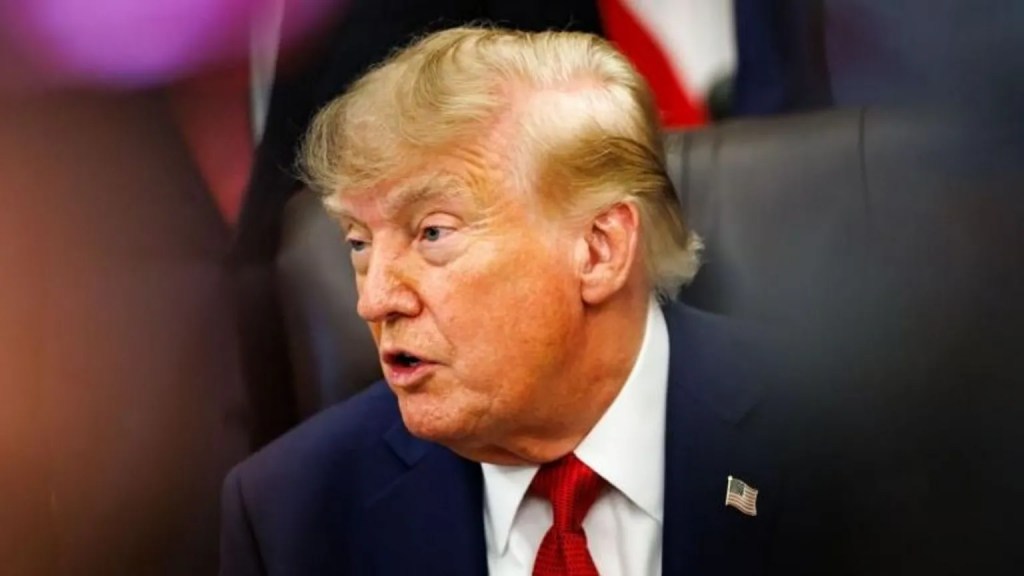
Donald Trump has postponed the implementation of major sanctions against Russia, reopening a difficult debate about whether economic pressure can remain credible when the country imposing it becomes increasingly vulnerable to the consequences. On 16 October, Trump signed an executive order waiving sanctions and tariffs under the recently enacted Graham Act, which was intended to increase pressure on Moscow over its war in Ukraine. Secretary of State Marco Rubio subsequently confirmed that the administration would take up to 60 days to assess the economic consequences before making a final decision. The measures included penalties on countries purchasing Russian oil and gas, potentially affecting major American partners such as India. Washington has also reached an agreement to obtain Russian diesel supplies, with an initial shipment exceeding 300,000 metric tonnes, as the continuing conflict with Iran disrupts global energy markets. Ukraine has criticised the decision, arguing that reducing economic pressure risks encouraging further Russian aggression. The contradiction is difficult to ignore: America wants to use economic interdependence to constrain Russia, but its own dependence on stable energy markets is beginning to constrain America’s willingness to use that leverage. <Cite ref=”turn560254news15″/>
This is an important illustration of why sanctions should not be understood simply as instruments through which powerful states punish weaker ones. Their effectiveness depends on the distribution of economic costs between the sender and the target. A sanction becomes strategically attractive when it imposes sufficiently large costs on the target while remaining politically sustainable for the country enforcing it. But energy markets complicate this relationship because oil and petroleum products are globally traded commodities. Restricting Russian exports can reduce Moscow’s revenue, yet it can also raise prices for consumers elsewhere if alternative supplies are insufficient. The United States therefore faces a conflict between two objectives it considers legitimate: weakening Russia’s capacity to sustain military operations and protecting American households from another increase in fuel prices. The difficulty is not that Washington has suddenly abandoned strategic interests in Ukraine, but that pursuing one strategic interest has become more expensive because of another conflict.
The Iranian war has made this contradiction considerably sharper. Tehran continues to restrict normal navigation through the Strait of Hormuz, while Washington maintains pressure on Iranian ports and oil exports. Iranian Foreign Minister Abbas Araqchi reiterated today that Tehran could reopen the waterway within approximately a week if the United States accepted conditions including lifting the blockade, removing oil sanctions and ending hostilities across regional fronts. Washington, however, wants meaningful restrictions on Iran’s uranium enrichment capacity incorporated into negotiations. The disagreement has left a maritime corridor historically responsible for approximately one-fifth of global oil and liquefied natural gas trade at the centre of another unresolved geopolitical confrontation. <Cite ref=”turn560254news16″/> The two conflicts are now economically connected even though their political causes differ. Pressure on Iran increases the value of Russian energy, while dependence on Russian energy reduces the credibility of American economic pressure against Moscow.
This creates what economists would recognise as a problem of interdependent policy constraints. Governments frequently design foreign-policy instruments as though each crisis can be managed separately. Sanctions against Russia are evaluated according to their effect on Russian revenue; restrictions against Iran are evaluated according to nuclear and regional-security objectives. But markets aggregate these decisions. Removing energy from one supplier increases demand for alternatives, while restricting several suppliers simultaneously can produce price increases large enough to change domestic political incentives. The marginal cost of sanctioning Russia is therefore higher when Iranian energy supplies are already disrupted. Foreign policy cannot be optimised independently across conflicts when the same commodity markets transmit their consequences.
Trump’s decision also exposes the relationship between democratic accountability and strategic consistency. The administration faces American midterm elections in November, making energy prices particularly politically sensitive. Voters experience foreign policy through domestic purchasing power, even when the underlying strategic objectives are geographically distant. This is not necessarily evidence of democratic weakness. Citizens have legitimate reasons to question policies that impose economic costs on them. The difficulty arises when governments make long-term security commitments but remain unwilling to explain or distribute the domestic sacrifices required to sustain them. A strategy dependent on public endurance cannot remain credible if political leaders treat every economic consequence as something that must be avoided immediately.
Ukraine’s concern is therefore understandable. Economic sanctions work partly because the targeted state believes the restrictions will remain in place long enough to change its calculations. If Moscow expects Washington to suspend penalties whenever global energy prices become politically inconvenient, the expected future cost of Russian aggression falls. Sanctions then become less effective even before they are formally removed, because their credibility has already weakened. This is the same commitment problem that appears in military deterrence: a threat is valuable not simply because a state possesses the capability to carry it out, but because the adversary believes the state will remain willing to carry it out when doing so becomes costly.
Yet the opposite position also deserves scrutiny. Insisting that sanctions remain unchanged regardless of economic circumstances would confuse strategic consistency with inflexibility. If the cost imposed on American consumers and international partners becomes disproportionately large relative to the additional pressure on Moscow, adjusting the policy may be rational. The appropriate question is therefore not whether sanctions should ever be relaxed, but whether relaxation is connected to a coherent bargaining strategy. Temporary relief linked to verifiable Russian concessions could preserve leverage. Suspending restrictions primarily because energy prices have increased risks teaching Moscow that continued resistance will eventually generate economic pressure on the countries enforcing the sanctions.
India occupies an especially complicated position. New Delhi has purchased substantial quantities of Russian oil while maintaining a strategic partnership with Washington and extensive economic relationships with Europe. American secondary tariffs would effectively attempt to make India’s energy choices instruments of American Russia policy. India has legitimate reasons to resist that arrangement because energy affordability directly affects Indian inflation, industrial competitiveness and household welfare. However, strategic autonomy should not be confused with the claim that commercial decisions have no geopolitical consequences. Russian energy purchases generate revenue for Moscow, just as restrictions on those purchases can impose costs on Indian consumers. An independent foreign policy requires acknowledging those competing consequences and defending the resulting choices, rather than pretending the trade-offs do not exist.
The broader philosophical issue concerns the relationship between economic sovereignty and political authority. States formally possess the right to determine their foreign policies, but global markets constrain which policies remain affordable. A government can legally impose an embargo while discovering that domestic inflation makes maintaining it politically difficult. Another government can legally refuse sanctions while discovering that access to international finance or export markets depends on compliance. Neither is completely autonomous in a material sense. This is why sovereignty should be understood as the capacity to make meaningful choices under conditions of interdependence, rather than the impossible absence of external constraints.
The current crisis also demonstrates that economic coercion can gradually undermine its own effectiveness. Countries threatened with secondary sanctions acquire incentives to diversify payment systems, suppliers and export markets. Energy importers invest in alternative sources. Financial institutions seek ways to reduce exposure to jurisdictions capable of freezing assets. These responses do not eliminate American financial power immediately, but they can reduce its effectiveness over time. The United States therefore needs to distinguish between using economic leverage selectively, where it can produce substantial concessions, and using it so extensively that other countries begin treating dependence on American-controlled systems as a strategic liability.
None of this establishes that sanctions are ineffective. They can restrict access to technology, raise financing costs and reduce the resources available for military production. But their effectiveness should be assessed against a counterfactual: how would Russia’s military and economic position have developed without them, and how much additional restraint would stronger sanctions actually produce? Measuring success only through the severity of restrictions risks confusing the intensity of punishment with the achievement of political objectives. The purpose of economic statecraft is to change behaviour, not merely to demonstrate the capacity to inflict economic damage.
Trump’s 60-day review therefore represents more than another adjustment in American sanctions policy. It reveals the limits of a foreign-policy approach attempting simultaneously to maximise coercion against several energy-producing states while minimising the domestic economic consequences. Those objectives cannot always be achieved together. Policymakers must decide which security interests justify which economic costs, explain those decisions publicly and construct commitments capable of surviving predictable political pressure.
The lesson is not that America should abandon sanctions against Russia or accept Iran’s demands over Hormuz. It is that economic power becomes strategically useful only when governments understand the dependencies through which that power operates, including their own. A country may possess the ability to impose extraordinary costs on an adversary, but if using that ability destabilises markets on which its own political and economic stability depends, coercion becomes a negotiation with its own vulnerabilities as much as with the adversary.
The central question after this week’s decision is therefore whether Washington can construct a policy in which economic pressure remains credible without becoming economically unsustainable. Power is not simply possessing leverage over another state. It is possessing enough control over the consequences of using that leverage that the state can afford to follow through.

