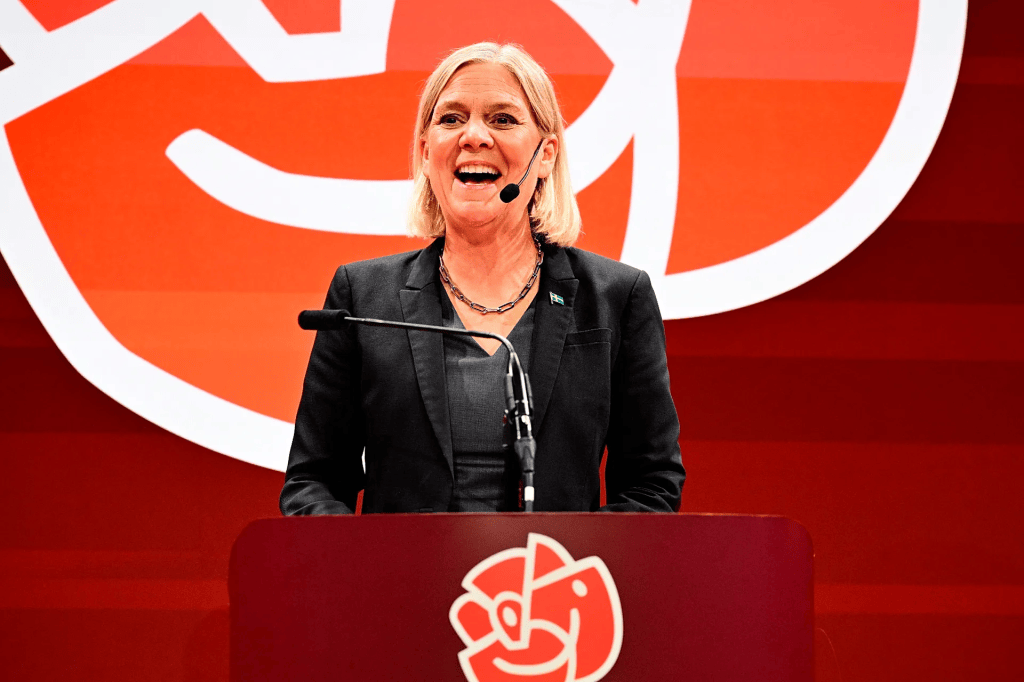
Sweden’s election has produced a narrow advantage for the centre-left opposition led by former prime minister Magdalena Andersson, potentially ending four years of conservative government supported by the right-wing Sweden Democrats. The result is particularly interesting because Sweden has spent the past decade confronting many of the political forces reshaping Europe: immigration, gang violence, integration failures, rising support for nationalist parties and declining confidence in the older social-democratic consensus. Yet this election does not appear to represent a simple return to the Sweden of twenty years ago. Andersson’s Social Democrats have themselves adopted considerably tougher positions on migration and crime, while the political right has forced questions of integration and security permanently into the mainstream. Reuters reported that the centre-left emerged with a narrow lead, although the Social Democrats’ own vote share remained historically weak and difficult coalition negotiations were expected. The result therefore illustrates something more interesting than another European election changing governments: political parties can lose elections while still winning the argument over which problems politics is required to take seriously.
This is one reason the conventional language of “left versus right” increasingly explains less than it appears to. Sweden’s centre-left can support a generous welfare state, collective bargaining and comparatively high taxation while simultaneously favouring stricter immigration rules and stronger policing. Voters do not necessarily possess one ideological preference from which every policy position follows. Someone can support redistribution because they believe economic inequality limits meaningful freedom while supporting restrictive migration. After all, they believe the state has obligations primarily towards citizens already participating in its political community. Whether that combination is morally persuasive is debatable, but it is not logically incoherent. Political philosophy becomes less useful when ideologies are treated as complete packages rather than competing answers to different questions about justice, community and authority.
Migration has forced European social democracy to confront precisely this tension. Universalist political morality suggests that a person’s welfare should not matter less simply because they were born outside Sweden. Democratic welfare states, however, are financed and administered through bounded political communities. Citizens pay taxes partly because they expect other members to participate in a reciprocal system over time. Large-scale immigration can therefore generate a question that neither unrestricted cosmopolitanism nor simple nationalism answers adequately: how open can a solidaristic welfare state remain while preserving enough social trust that citizens continue consenting to redistribution? The empirical answer will vary by labour-market integration, fiscal contribution and institutional capacity, but the philosophical tension is real.
The Sweden Democrats built much of their rise around the argument that establishment parties refused to acknowledge this problem. Sweden accepted unusually high levels of asylum migration during the 2015 European refugee crisis, after which integration difficulties and highly visible gang violence became politically salient. It would be analytically careless to claim immigration alone caused Swedish crime; criminal violence reflects segregation, drug markets, policing, inequality and other factors. It would be equally careless to insist migration had no relevance simply because acknowledging a relationship might benefit the political right. When mainstream parties refuse to discuss a genuine problem because they dislike the political actors discussing it, they surrender both credibility and agenda-setting power to those actors.
The Social Democrats appear to have learnt this. Their harder approach towards migration and crime does not necessarily mean Sweden has become ideologically right-wing. It means democratic competition has produced policy convergence where public preferences changed. This is one of democracy’s strengths. Parties adapt because citizens can remove them. Political movements that refuse adaptation in the name of ideological purity can remain morally coherent while becoming electorally irrelevant.
Yet there is a danger in allowing public anxiety to determine policy without liberal constraints. A majority concerned about crime can demand stronger policing, but criminal responsibility remains individual. A majority concerned about integration can support lower immigration, but existing citizens and lawful residents do not become less entitled to equal treatment because they belong to an ethnic or religious minority. This is where liberal democracy differs from simple majoritarianism. Democracy tells us who possesses authority to make collective decisions; liberalism places boundaries around what majorities should be permitted to do with that authority.
The Sweden Democrats therefore pose an important institutional test. They have become a substantial electoral force and cannot simply be treated as politically nonexistent because established parties dislike parts of their history or programme. Excluding a large constituency permanently from influence can itself weaken democratic legitimacy. But participation in democratic politics does not entitle any party to weaken equal citizenship, judicial independence or minority rights. The appropriate response is neither automatic exclusion nor normalisation without scrutiny. It is to judge concrete policies against constitutional principles while accepting the legitimacy of voters who choose them.
Sweden’s welfare model creates another interesting dimension because high social expenditure depends partly on a productive private economy capable of financing it. The traditional Swedish model was never simply “large government”. It combined high taxation and extensive welfare with open trade, globally competitive firms and relatively strong institutions. Companies such as Volvo, Ericsson, IKEA and Spotify emerged from an economy deeply integrated into global markets. The model therefore demonstrates something often lost in ideological arguments: markets generate resources and states can redistribute them; weakening either side of that relationship eventually weakens the other.
This becomes harder as Sweden increases defence spending following its accession to NATO. The country abandoned more than two centuries of formal military non-alignment after Russia’s invasion of Ukraine transformed perceptions of European security. Defence now competes with healthcare, pensions, policing and climate policy for fiscal resources. Political choices that were previously separable become connected through the budget. Citizens can demand a stronger welfare state and stronger military simultaneously, but the state eventually needs enough taxation and economic growth to finance both.
NATO membership itself represents an interesting shift in Swedish ideas about sovereignty. For decades, neutrality was understood as protecting independence by avoiding binding military alliances. Russia’s invasion produced the opposite conclusion: sovereignty could be protected more effectively by sharing defence obligations with other states. This demonstrates that autonomy and cooperation are not opposites. A state can voluntarily surrender some freedom of action in order to increase its practical capacity to protect more important freedoms.
The same logic applies to the European Union. Sweden accepts common European rules that constrain national discretion because access to a larger market and collective bargaining power can increase Swedish prosperity and influence. Sovereignty in the modern world therefore cannot sensibly mean complete freedom from external rules. No country participating deeply in trade, finance or security possesses that. The more useful concept is agency: whether a political community retains meaningful influence over the institutions constraining it and enough alternatives to prevent those constraints becoming domination.
Andersson’s potential return therefore should not be interpreted as Sweden rejecting the political transformation of the past decade. The centre-left has survived partly by incorporating parts of that transformation itself. Migration policy is stricter. Security occupies much more political attention. NATO membership is established. The Sweden Democrats have changed the policy agenda even if they do not lead the next government. This is a reminder that elections produce two kinds of victory: one determines who occupies office; the other determines which questions every party seeking office is forced to answer.
The danger for Sweden is allowing legitimate debates over migration and security to erode the universal character of citizenship. The danger for the centre-left is assuming that moral condemnation of nationalist politics can substitute for solving the problems that made nationalist politics attractive. The danger for the right is assuming that stronger borders and policing alone can solve failures of integration that also require education, employment and functioning urban institutions.
Sweden’s political shift therefore is less dramatic than either side may claim. The country is not simply returning left or continuing right. Its political centre is being reconstructed around a different combination of welfare, security, migration control and European cooperation.
That may be how democratic systems adapt successfully. They do not preserve themselves by refusing to change when citizens’ concerns change; they preserve themselves by allowing policy to change without allowing the basic equality of citizenship and constitutional limits on power to change with it.

