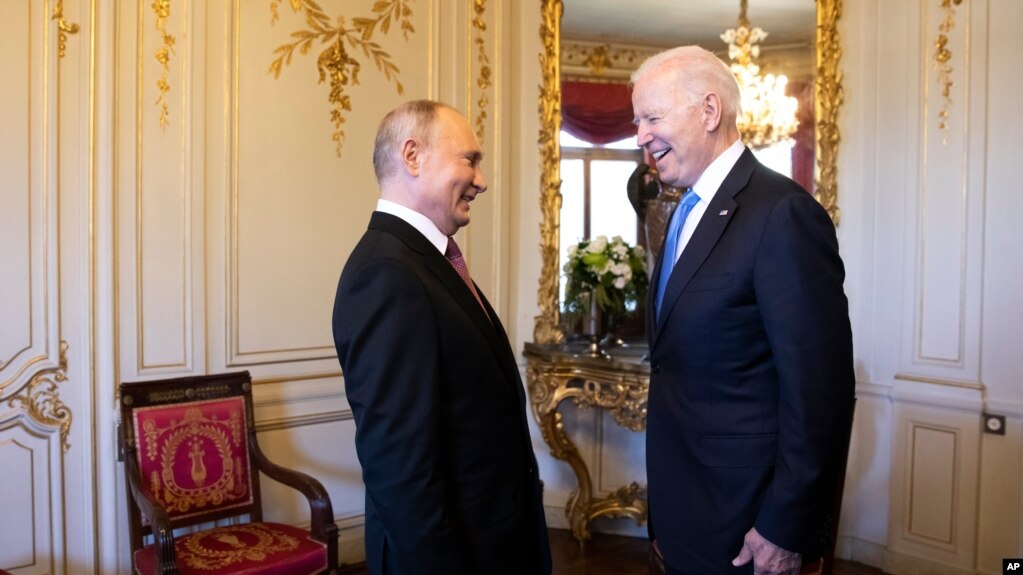
On Wednesday, Joe Biden sat across a table from Vladimir Putin in Geneva.
There was no dramatic agreement.
No “reset” of American-Russian relations.
No announcement that years of hostility had suddenly disappeared.
After several hours, the two presidents emerged separately, held separate press conferences and acknowledged that they continued to disagree about almost everything that brought them there in the first place.
Strangely, I think that may be why the meeting mattered.
We often judge diplomacy by breakthroughs. A summit is successful if leaders sign a treaty, resolve a dispute or announce some enormous new partnership.
But the relationship between the United States and Russia has deteriorated so severely that perhaps expecting friendship is the wrong standard.
Biden himself described the relationship much more realistically after the meeting:
“This is not about trust.”
It is about interests.
That might be one of the clearest explanations of diplomacy I have heard.
Because countries do not need to like one another to have reasons not to accidentally start a war.
What actually happened in Geneva?
The meeting produced several concrete, although fairly modest, outcomes.
The United States and Russia agreed to return their ambassadors to Moscow and Washington after both had previously been recalled.
They agreed to begin a dialogue on strategic stability and nuclear arms control.
They also agreed to begin discussions about cybersecurity.
Those announcements are hardly revolutionary.
The disagreements remain enormous.
Washington accuses Russia of interfering in American elections and carrying out or tolerating malicious cyber activity. Biden raised the imprisonment of Russian opposition leader Alexei Navalny and warned of serious consequences if Navalny died in prison.
The two countries remain divided over Ukraine after Russia’s annexation of Crimea in 2014 and its support for separatists in eastern Ukraine.
Putin, meanwhile, rejected many American accusations and repeatedly pointed towards problems inside the United States when questioned about Russian human rights abuses.
Nobody walked out of Geneva pretending these disputes had disappeared.
But perhaps the most important accomplishment was establishing that they could discuss them without pretending they had disappeared.
The strange politics of “being tough”
Almost every American president eventually faces the same political test:
Are you being tough enough on Russia?
It is an understandable question.
Putin’s government has repeatedly behaved in ways that threaten American and European interests. A president who simply ignores that behaviour risks signalling that there are no consequences.
But I am becoming increasingly suspicious of the word “tough” in foreign policy.
What does it actually mean?
More sanctions?
Fewer meetings?
Harsher speeches?
Military deployments?
Calling Putin unpleasant names?
All of those things can make a government appear tougher.
That does not necessarily make them effective.
Foreign policy should probably be judged by whether it changes outcomes rather than whether it creates the appearance of strength.
Sometimes refusing to meet an adversary may isolate them.
Sometimes it simply means you no longer have a way to communicate with them.
And when the adversary controls thousands of nuclear weapons, communication seems fairly useful.
The nuclear weapons nobody talks about anymore
Perhaps the least dramatic part of the summit is actually the most important.
The United States and Russia possess the overwhelming majority of the world’s nuclear weapons.
Earlier this year, they extended the New START treaty, which limits deployed strategic nuclear weapons and the systems used to deliver them.
Now they have agreed to begin further strategic stability discussions.
Nuclear arms control rarely receives the same attention it did during the Cold War.
Maybe that is because nuclear weapons have existed for so long that they have become strangely ordinary.
They shouldn’t be.
Two governments that distrust one another possess enough destructive power that a serious miscalculation between them could have consequences unlike almost any other political mistake.
That creates a strange relationship.
America and Russia can simultaneously be adversaries and require each other’s cooperation.
Neither country needs to believe the other is morally good.
Neither even needs to believe the other is particularly trustworthy.
They simply need to recognise that certain outcomes would be catastrophic for both.
That is cooperation built not on friendship but on mutual vulnerability.
And it may actually be more durable because neither side needs to pretend otherwise.
Cyberwarfare makes this much harder
One of the most interesting discussions this week concerned something much newer than nuclear weapons: cyberattacks.
The United States has suffered several major cyber incidents recently, including the SolarWinds intrusion and the ransomware attack that temporarily shut down the Colonial Pipeline.
Biden told Putin that sixteen categories of American critical infrastructure should effectively be treated as off-limits to destructive cyberattacks.
The idea sounds almost like an attempt to create rules for a new kind of conflict.
But cyberwarfare creates problems that nuclear deterrence does not.
If a nuclear missile is launched from Russia towards the United States, determining where it came from is comparatively straightforward.
A cyberattack can be routed through computers across multiple countries.
The attacker may not even officially work for a government.
Criminal organisations can operate from a country’s territory without necessarily receiving direct instructions from its government.
That creates ambiguity.
If Russian criminals attack an American pipeline, how responsible is the Russian government?
If Moscow knows who they are and chooses not to stop them, does that responsibility change?
At what point does tolerating an attack become equivalent to sponsoring it?
And how should the United States respond?
With sanctions?
Arrests?
A cyberattack of its own?
These are questions governments are still trying to answer.
Technology has advanced faster than the political rules governing it.
Deterrence requires communication
Biden also reminded Putin that the United States possesses significant cyber capabilities of its own.
That was clearly intended as a warning.
But an effective warning requires the other side to understand two things:
what behaviour will produce retaliation,
and roughly where the boundary lies.
This is one reason communication between adversaries matters.
Deterrence is often described as threatening somebody.
It is actually more complicated.
Imagine I tell someone:
“If you cross the line, there will be consequences.”
The obvious question is:
Which line?
If the boundary is unclear, they may cross it accidentally.
If every action produces the same threat, they may stop believing the threat.
If the punishment is completely disproportionate, carrying it out may harm me too.
The objective therefore isn’t simply to frighten an adversary.
It is to make their calculation predictable.
That may be what Biden means when he talks about establishing “rules of the road”.
Not friendship.
Predictability.
Human rights create a harder contradiction
There is one area where interests and values become much more difficult to separate.
Human rights.
Biden says American foreign policy will again emphasise democratic values. He raised Alexei Navalny directly with Putin and said Russia would face devastating consequences if Navalny died.
Putin responded by pointing towards America’s own problems, including gun violence and Guantánamo Bay.
This is a familiar political strategy: when accused of wrongdoing, point towards the accuser’s hypocrisy.
Sometimes that hypocrisy is real.
America’s own human-rights record is obviously not spotless.
But hypocrisy does not make the original criticism false.
If a smoker tells me cigarettes are unhealthy, the fact that they smoke does not suddenly make cigarettes healthy.
At the same time, countries do lose credibility when they demand standards from others that they do not consistently apply themselves.
Both things can be true.
America can legitimately criticise repression in Russia.
Russia can legitimately point towards contradictions in American behaviour.
Neither observation automatically cancels the other.
The harder question is what happens when values conflict with interests.
America condemns Putin’s treatment of political opponents.
America also needs Putin’s government to negotiate nuclear weapons, cybersecurity, Iran, Syria and other issues.
Refusing to speak with Russia until it becomes democratic would certainly demonstrate moral consistency.
It would also mean refusing to negotiate with one of the world’s largest nuclear powers.
Foreign policy rarely offers the luxury of dealing only with governments you approve of.
Putin also wanted this meeting
It would be a mistake to analyse the summit as though Biden was the only person making calculations.
Putin had reasons to be in Geneva too.
Russia remains militarily powerful, possesses nuclear weapons and holds a permanent seat on the United Nations Security Council.
But its economy is much smaller than America’s, China’s or the European Union’s.
A bilateral summit with the American president reinforces something Putin has consistently sought: recognition of Russia as a major power whose interests cannot simply be ignored.
That gives Biden another dilemma.
Meeting Putin creates a channel for diplomacy.
It also gives Putin status.
Sometimes diplomacy itself is a concession.
That does not mean the meeting should not have happened.
It means every diplomatic interaction has more than one audience.
Biden was speaking to Putin.
He was also speaking to American voters, European allies and other governments watching how Washington deals with Moscow.
Putin was doing exactly the same thing.
Maybe success means nothing happens
This is where I think my understanding of diplomacy has changed most.
We notice foreign policy when something happens.
A treaty is signed.
A war begins.
A government collapses.
A missile is launched.
But some of the most successful diplomacy may produce nothing visible at all.
No cyberattack.
No accidental military confrontation.
No nuclear escalation.
No diplomatic crisis.
That creates a strange problem.
Politicians receive credit for solving crises.
They receive much less credit for preventing crises that therefore never become visible.
If the Geneva summit ultimately creates clearer communication between Washington and Moscow, we may never know which future misunderstandings it prevented.
And if nothing improves, critics will reasonably ask what the meeting achieved.
Biden himself acknowledged this.
The summit cannot really be judged this week.
It has to be judged by what happens next.
Diplomacy without illusions
I don’t think Biden should trust Putin.
I doubt Putin particularly trusts Biden either.
Perhaps that is fine.
International relations would be much simpler if countries could divide themselves into friends and enemies.
Friends cooperate.
Enemies are confronted.
Reality seems considerably messier.
Countries can oppose one another in Ukraine while cooperating on nuclear weapons.
They can impose sanctions while maintaining embassies.
They can condemn each other’s political systems while negotiating cybersecurity.
They can compete and cooperate simultaneously.
That isn’t hypocrisy.
It is what happens when countries have multiple interests that do not fit neatly into a single relationship.
Last week, the G7 summit presented international politics partly as a competition between democracies and authoritarian states.
That competition is real.
But Geneva revealed the other half of the picture.
Even governments competing over the future of the international system still have to share that system.
America cannot make Russia disappear.
Russia cannot make America disappear.
Neither can afford to misunderstand the other badly enough when nuclear weapons are involved.
Perhaps the purpose of diplomacy is therefore not always to resolve disagreement.
Sometimes it is simply to make disagreement manageable.
That sounds like an incredibly low standard for a presidential summit.
When the alternative is two nuclear powers misunderstanding each other, it may actually be a remarkably important one.

