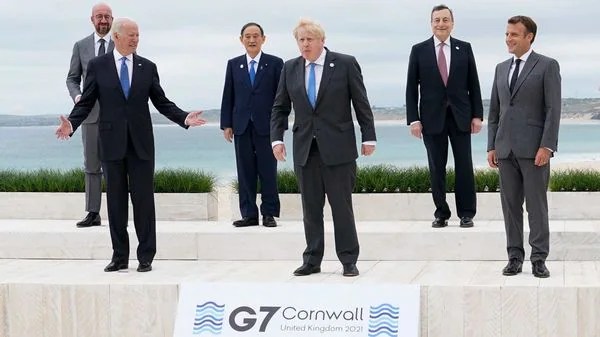
For three days this week, seven of the world’s wealthiest democracies met on the Cornish coast.
There were the usual photographs: leaders standing beside the sea, elbow bumps instead of handshakes, carefully arranged bilateral meetings and an enormous communiqué containing promises on everything from vaccines to climate change.
But underneath all of that was a much larger political argument.
The G7 is trying to prove that it still matters.
And, perhaps more importantly, that the political system its members represent still works.
President Joe Biden arrived in Britain on his first foreign trip since taking office with a very different message from Donald Trump’s “America First” foreign policy. America, Biden says, is back. Alliances matter again. Multilateral institutions matter again. Democracies should cooperate.
That sounds reassuring.
But saying “America is back” immediately creates another question.
Back to what?
The world Biden has returned to is not the world America dominated after the Cold War.
China is much more powerful. Russia remains willing to challenge Western governments. Developing economies account for an increasingly important share of global growth. COVID-19 has exposed enormous inequalities between rich and poor countries.
The G7 can still coordinate some of the world’s most powerful democracies.
It can no longer assume that coordinating them is the same thing as coordinating the world.
China was not in Cornwall, but it was everywhere
China was probably the most important country at this summit that was not actually invited.
The final G7 statement raised concerns about human rights in Xinjiang, Hong Kong and stability across the Taiwan Strait. Leaders also discussed economic practices and the broader challenge posed by China’s growing international influence.
But perhaps the most interesting response to China was not contained in the criticism.
It was contained in an infrastructure proposal.
The G7 announced Build Back Better World, or B3W, an initiative intended to help finance infrastructure in developing countries.
That may sound unrelated to geopolitics.
It isn’t.
Since 2013, China’s Belt and Road Initiative has financed and constructed infrastructure across Asia, Africa, Europe and elsewhere: roads, railways, ports, energy projects and telecommunications networks.
Those projects create economic benefits.
They also create relationships.
If China finances your railway, builds your port, supplies your telecommunications equipment and becomes one of your largest trading partners, China’s importance to your government increases.
Infrastructure therefore becomes foreign policy made out of concrete.
The G7 has finally decided that criticising China’s Belt and Road is not enough.
It needs to offer an alternative.
That is an important change.
Competition might actually be useful
Western governments frequently describe China’s growing influence as a threat.
From their perspective, that is understandable.
But imagine looking at the competition from the perspective of a developing country that needs a new railway.
China offers to finance it.
Now the G7 offers an alternative.
Why would that country necessarily dislike having two options?
Competition between major powers can be dangerous when it becomes military. But competition over who can provide better infrastructure, cheaper financing or more useful technology could actually benefit countries receiving those offers.
If China wants influence, it has to make its proposal attractive.
If the United States and Europe want influence, they have to make theirs more attractive.
The developing country gains bargaining power.
This is why I think the language surrounding China sometimes becomes too simplistic.
Western governments frequently ask whether a country is moving “towards China” or “towards the West”, as though governments around the world are waiting to select teams.
Many probably don’t want to.
India is a good example.
India has serious strategic disagreements with China, particularly after the deadly border confrontation last year. It also has increasingly close relationships with the United States, Japan and Australia through the Quad.
But India is not suddenly an American ally in the traditional sense.
It has its own interests.
That seems obvious, yet powerful countries often appear surprised when smaller countries behave as though they have interests of their own.
There is also an awkward question: who asked the G7 to lead?
The G7 consists of the United States, Britain, Canada, France, Germany, Italy and Japan, with the European Union also participating.
These are enormously wealthy countries.
But look at who isn’t permanently represented.
China.
India.
Brazil.
Indonesia.
Almost all of Africa.
The G7 was created in a period when its members represented a much larger share of the world economy.
That balance has changed.
India was invited to participate in parts of this summit, alongside Australia, South Korea and South Africa. Prime Minister Narendra Modi joined discussions virtually because of India’s COVID situation.
Inviting these countries is useful.
But an invitation is not the same thing as membership.
This creates a legitimacy problem.
The G7 wants to establish global rules on taxation, climate change, trade, infrastructure and international security.
But can rules created principally by wealthy Western democracies and Japan really be called global before the countries expected to follow them have helped shape them?
Last week I wrote about exactly this problem with the global minimum corporate tax.
Seven finance ministers agreeing on a rule is significant.
It is not the same thing as the world agreeing.
This week’s summit makes that distinction even clearer.
The vaccine promise
COVID-19 makes the inequality particularly difficult to ignore.
G7 leaders have now promised hundreds of millions of additional vaccine doses for poorer countries, contributing towards a commitment of more than one billion doses through donations and financing.
That is important.
People will receive vaccines who otherwise might have waited much longer.
But there is something uncomfortable about wealthy countries presenting vaccine donations as generosity when many of those same countries bought enormous quantities of vaccines early in the pandemic while poorer countries struggled to secure supply.
This does not make the donations meaningless.
It does make the word “leadership” more complicated.
If I buy ten umbrellas during a storm and later give one to somebody standing in the rain, giving them the umbrella is still good.
But I probably shouldn’t congratulate myself too enthusiastically for solving the umbrella shortage.
The same problem applies internationally.
Rich countries had the money and purchasing power to secure vaccines first. Their governments also had a responsibility to protect their own citizens.
I cannot really criticise a government for prioritising the people who elected it.
But if every government prioritises only its own citizens during a global pandemic, poorer countries inevitably lose.
Once again, individually rational decisions can produce a collectively terrible outcome.
That seems to be becoming a recurring theme in international politics.
What does “America is back” actually mean?
Biden’s presence has changed the atmosphere considerably from recent G7 meetings.
Trump frequently criticised allies and questioned international institutions that previous American presidents had treated as foundations of US power.
Biden appears to see those same alliances as an advantage.
I think that makes strategic sense.
America cannot compete with China simply by telling other countries that China is dangerous.
It needs partners.
And partners are more useful when they believe cooperation benefits them too.
But there is a danger in treating Biden’s election as though the international system has simply returned to normal.
Trump was not an interruption that can be deleted from history.
He was elected.
Other governments know that another American president could reverse Biden’s policies again.
That affects trust.
Imagine negotiating a climate agreement, trade arrangement or security strategy with a country when its foreign policy might change dramatically every four years.
Democracies frequently criticise authoritarian governments for lacking political accountability.
Authoritarian governments can point to a different weakness in democracies: inconsistency.
A president can make a commitment.
The next president can abandon it.
This doesn’t make authoritarian government preferable. Stability without accountability can simply mean consistently pursuing a terrible policy.
But democratic governments cannot assume their system has no strategic disadvantages.
Democracy has to compete on performance
This, I think, is the most interesting part of Biden’s message.
The argument between democracies and authoritarian governments is no longer only philosophical.
It is becoming practical.
Which system can build infrastructure faster?
Which can respond to pandemics better?
Which can produce economic growth?
Which can address climate change?
Which can provide vaccines?
Which can make international agreements and actually implement them?
China does not need to persuade every country to become communist in order to increase its influence.
It simply needs governments to conclude that working with Beijing produces useful results.
That means democracies cannot defend themselves only by saying that democracy is morally superior.
They have to govern effectively.
Rights matter.
Elections matter.
Freedom of speech matters.
But people also expect governments to deliver electricity, roads, hospitals, vaccines, employment and economic security.
If democratic governments cannot do those things, telling people that their institutions are superior eventually becomes less convincing.
The contradiction at the centre of the G7
And that brings me back to the strange contradiction of this summit.
The G7 is simultaneously extraordinarily powerful and obviously insufficient.
Its members possess enormous economic resources, advanced militaries, technological capabilities and diplomatic influence.
When they coordinate, they can change international behaviour.
But they cannot solve climate change by themselves.
They cannot establish a genuinely global corporate tax by themselves.
They cannot vaccinate the world by themselves.
They cannot determine China’s behaviour by themselves.
They cannot simply announce a new infrastructure programme and expect developing countries to prefer it.
The age in which a small group of Western powers could establish rules and expect much of the world to accept them is disappearing, if it has not disappeared already.
That does not make the G7 irrelevant.
It changes what relevance means.
Leadership in a more multipolar world cannot simply mean having enough power to make the rules.
It increasingly means having enough credibility to persuade countries that did not write those rules that following them is in their interests.
The real competition
There will be plenty of discussion after this summit about whether the G7 has become more united against China.
I think that slightly misses the point.
The most important competition may not ultimately be the West against China.
It may be between different answers to a much simpler question:
Who can actually deliver?
China has spent years building infrastructure through the Belt and Road.
The G7 has now announced an alternative.
Good.
Now it has to build something.
The G7 has promised vaccines.
Good.
Now those doses have to reach people.
It has endorsed a global minimum tax.
Good.
Now countries outside the G7 have to agree.
Biden says democracies can meet the great challenges of this century.
I hope he is right.
But democracy does not win an argument simply because democratic leaders announce that it should.
If the G7 wants to demonstrate that democratic government still deserves to lead internationally, photographs in Cornwall will not prove it.
Results might.

