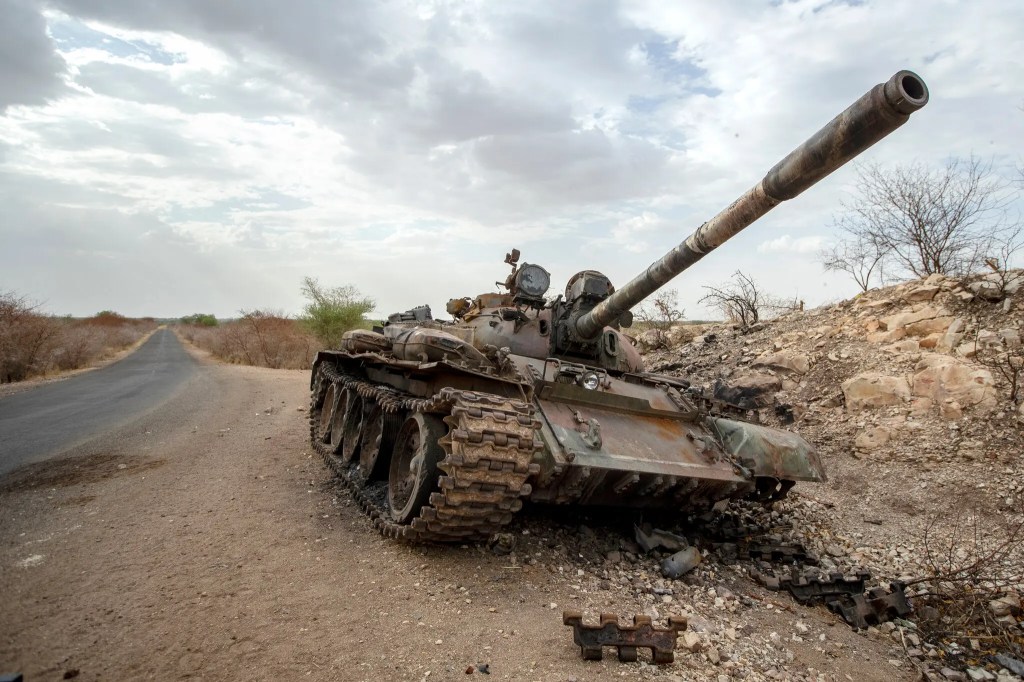
Last Sunday, I ended my post about Ethiopia’s election with a question.
Could Prime Minister Abiy Ahmed use an electoral mandate to find a political solution to the war in Tigray?
Twenty-four hours later, the war changed dramatically.
On Monday, Tigrayan forces entered Mekelle, the regional capital that Ethiopia’s federal army had captured in November.
Crowds reportedly celebrated in the streets.
Officials from Ethiopia’s interim administration fled.
The federal government then announced what it described as a unilateral humanitarian ceasefire.
Only seven months ago, Abiy’s government had captured the same city and declared that the major military operation was over.
It wasn’t.
This week’s events therefore raise a question much larger than Ethiopia:
Why are governments so good at capturing cities and so bad at recognising when that does not mean they have won?
What happened?
The speed of the reversal is remarkable.
For months, forces aligned with the Tigray People’s Liberation Front had continued fighting the Ethiopian military and its allies despite the federal government’s capture of Mekelle last November.
Recently, those Tigrayan forces launched a major offensive.
Then, on Monday, they retook Mekelle.
The Ethiopian government subsequently announced a unilateral ceasefire that it said was intended partly to allow farmers to plant crops and humanitarian organisations to operate.
There are therefore two very different interpretations of what happened.
The government’s version is essentially that it made a political and humanitarian decision to withdraw.
The Tigrayan side sees what happened as a military victory.
Both descriptions can contain elements of truth.
A government can choose to withdraw because continuing to hold territory has become militarily costly.
But describing that withdrawal as voluntary does not tell us why the calculation changed.
That is why language becomes so important during wars.
Governments rarely announce:
“Our strategy failed.”
They announce a redeployment.
A tactical adjustment.
A humanitarian ceasefire.
A new phase.
Sometimes those descriptions are accurate.
Sometimes they are ways of making military setbacks politically survivable.
Capturing a capital is not the same as controlling a population
When Ethiopian federal forces captured Mekelle in November, it looked decisive.
The government controlled the regional capital.
TPLF leaders had fled.
Abiy declared the military operation complete.
From a conventional military perspective, that made sense.
Governments control territory.
Capitals represent political authority.
Capture the capital, remove the leadership, install a new administration and the conflict should end.
Except the people you defeated do not necessarily agree that they have been defeated.
That seems to be the central mistake.
A military can capture a city much faster than a government can create legitimacy.
Those are completely different tasks.
The Ethiopian army could occupy Mekelle.
It could not force every Tigrayan to accept the political settlement imposed afterwards.
Once Tigrayan forces moved away from conventional confrontation and continued resistance elsewhere, the federal government faced a much more difficult problem.
It was no longer simply defeating an opposing army.
It was trying to govern a hostile region while fighting people who knew that region extremely well.
The stronger military does not automatically have the easier job.
The objectives are unequal
This is something I had not properly considered before.
Two sides fighting the same war do not necessarily need to accomplish the same amount in order to win.
For the federal government, victory requires something enormous.
It has to defeat organised Tigrayan resistance, control the territory, maintain functioning government and persuade enough of the population to accept federal authority that another rebellion does not simply begin afterwards.
For Tigrayan forces, the objective can be much smaller.
They have to make federal control too expensive to sustain.
That asymmetry matters.
Imagine somebody breaks into your house and tries to occupy it.
You have to remove them.
They have to remain indefinitely.
Time therefore benefits you differently.
Every additional day they stay requires resources, people and political commitment.
You only need to make staying sufficiently unpleasant that leaving eventually becomes preferable.
This helps explain why militarily stronger governments can lose wars against substantially weaker opponents.
The weaker side does not necessarily have to defeat the stronger military everywhere.
It has to survive.
Afghanistan should make this look familiar
It is difficult to watch Ethiopia this week without thinking about Afghanistan.
America invaded Afghanistan in 2001 and removed the Taliban government extraordinarily quickly.
Twenty years later, American forces are leaving while the Taliban remains capable of fighting across large parts of the country.
The comparison is obviously imperfect.
America is a foreign power leaving Afghanistan. Tigray is internationally recognised as part of Ethiopia.
The political structures, geography and history are completely different.
But the strategic problem contains an important similarity.
Military superiority can solve the first stage of a war while creating unrealistic expectations about the second.
Removing an opposing government can take weeks.
Building a political order that the population accepts can take decades.
And sometimes it cannot be done at all through military force.
That distinction may be one of the most important lessons of modern warfare.
Winning battles and achieving political objectives are not synonyms.
So did Abiy lose?
Not necessarily.
That conclusion would be premature.
The Ethiopian government still controls most of the country and possesses resources far greater than those available to the Tigrayan forces.
The conflict may continue.
The ceasefire may hold.
It may collapse.
Tigrayan forces may attempt to regain more territory.
The government may eventually launch another offensive.
We simply don’t know.
But this week unquestionably damages the government’s earlier claim that the conflict had effectively been resolved when Mekelle fell in November.
And that matters politically.
Governments do not only fight wars physically.
They construct narratives about them.
We are winning.
The enemy is nearly defeated.
Normality is returning.
Victory is close.
Those narratives help maintain public support.
But they also create a dangerous incentive.
Once a government has declared victory, acknowledging later setbacks becomes politically expensive.
The leadership is no longer merely explaining a changing military situation.
It is explaining why its previous explanation was wrong.
That can encourage governments to continue unsuccessful policies longer than they otherwise would.
Changing strategy begins to look like admitting failure.
The humanitarian ceasefire
There is another reason the ceasefire matters enormously.
Tigray is facing an increasingly severe humanitarian emergency.
Millions of people require assistance, and hundreds of thousands are facing catastrophic levels of hunger.
The conflict has repeatedly disrupted farming, transport and humanitarian access.
The Ethiopian government says its ceasefire will allow agricultural activity and aid delivery.
If that happens, it should be welcomed regardless of the political motivations behind the decision.
But announcing a humanitarian ceasefire is easier than creating humanitarian access.
Aid organisations need roads.
They need fuel.
They need communications.
They need security.
They need permission to move.
And they need all sides to allow supplies to reach civilians regardless of which political authority controls the territory.
This is where the consequences of war become much less abstract.
Military maps show territory in different colours.
They do not show whether the person living inside that territory can eat.
Eritrea makes everything more complicated
There is also an international dimension.
Eritrean forces have fought alongside Ethiopia’s federal government during the conflict.
Their presence is extraordinary considering that Abiy won the Nobel Peace Prize partly for ending Ethiopia’s long confrontation with Eritrea.
The country that was once Ethiopia’s enemy became its partner in a war inside Ethiopia.
That alone should warn us against treating alliances as permanent categories.
States cooperate because their interests align.
When those interests change, relationships can change astonishingly quickly.
But Eritrea’s involvement also complicates any ceasefire.
Ending a conflict becomes much harder when there are more than two armed actors.
Abiy cannot necessarily create peace simply by telling Ethiopian federal forces to stop fighting.
Tigrayan forces have their own objectives.
Eritrea has its own interests.
Amhara forces have their own territorial and political claims.
A conflict that begins as a confrontation between two actors can develop enough participants that nobody possesses complete control over how it ends.
Starting wars is sometimes much easier than assembling all the people necessary to stop them.
What does the election mean now?
There is also an uncomfortable connection to last week’s election.
Millions of Ethiopians voted.
Abiy is expected to receive a strong mandate.
But while ballots were being counted, the government’s military position in Tigray was deteriorating dramatically.
This demonstrates why electoral legitimacy and political effectiveness are different things.
A government can legitimately win an election and still pursue a failing military strategy.
It can be popular in one part of a country and deeply rejected in another.
It can possess constitutional authority without possessing effective control.
Political power has several dimensions.
Legal authority.
Popular support.
Military capacity.
Administrative control.
International recognition.
We often combine all of those into one word: government.
Tigray demonstrates why they should sometimes be separated.
Abiy’s government may possess legal sovereignty over Tigray.
That does not mean it currently possesses uncontested political control there.
The danger now is humiliation
The recapture of Mekelle will understandably be celebrated by many Tigrayans as liberation.
But military success creates its own political temptation.
Humiliation.
After months of reports of atrocities, displacement and hunger, demands for accountability are inevitable.
But if either side decides that victory requires humiliating the other rather than constructing a political settlement, the war may simply enter another phase.
This is particularly dangerous in a country as diverse as Ethiopia.
Abiy cannot permanently solve the Tigray question by military occupation.
But Tigrayan forces cannot solve Ethiopia’s constitutional problems simply by defeating federal troops around Mekelle either.
Eventually, somebody has to answer the political question that existed before the latest offensive:
How much power should Ethiopia’s regions possess, and how much should belong to the centre?
No battlefield can write a constitution.
The meaning of victory
Perhaps governments repeatedly misunderstand victory because military success is visible.
A city is captured.
A flag is raised.
An opposing army retreats.
Political success is much harder to photograph.
People accept institutions.
Former enemies participate in elections.
Local governments function.
Disputes are resolved without soldiers.
Citizens believe they have something to lose if the political system collapses.
Those achievements take years.
Sometimes generations.
And they rarely produce the dramatic moment that allows a leader to stand behind a podium and declare victory.
Maybe that is why governments are so often tempted to declare victory too early.
War provides a clear scoreboard.
Politics doesn’t.
Seven months ago, the Ethiopian government captured Mekelle and believed it had effectively won.
This week, the people it defeated walked back into the city.
That does not necessarily mean the Tigrayan forces have won either.
It means we may be using the wrong definition of victory.
The side that controls Mekelle tonight has won an important battle.
The side that eventually creates a political arrangement in which controlling Mekelle no longer requires a battle will have achieved something much more difficult.

