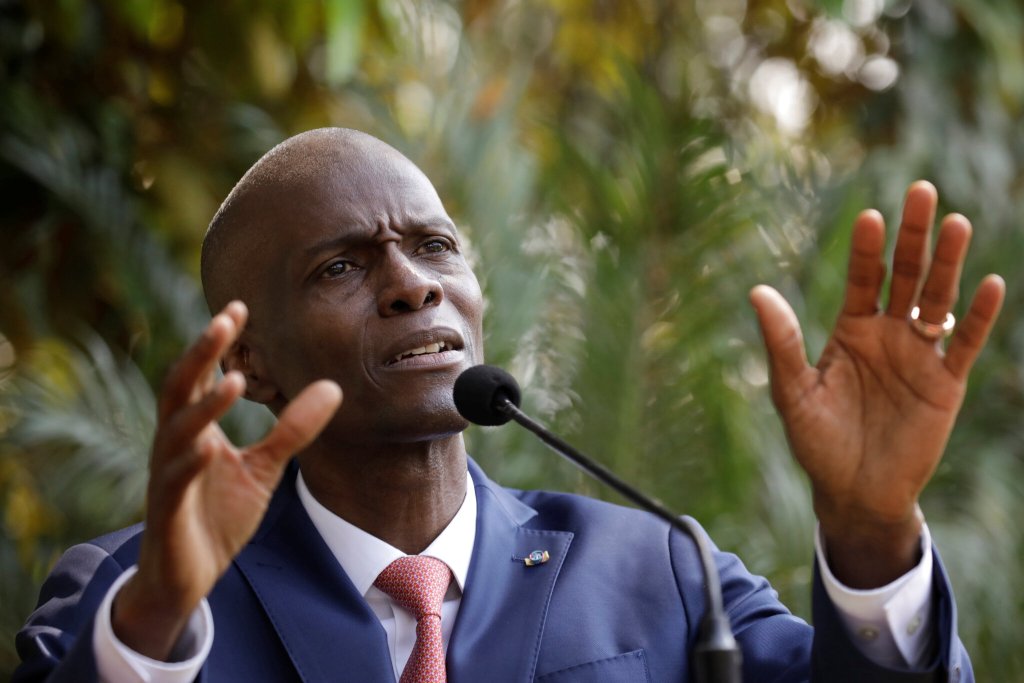
At around 1 a.m. on Wednesday, armed men entered the private residence of Haiti’s president, Jovenel Moïse.
They shot him dead.
His wife, Martine Moïse, was seriously wounded.
Since then, Haitian authorities have arrested a number of suspects, including former Colombian soldiers, while several others were killed by police. Investigators are still trying to determine who organised the operation and why.
Those questions matter enormously.
But there is another question that may be even more important for Haiti right now:
Who is actually in charge?
That should have a simple answer.
A president dies. The constitution establishes who replaces him. Government continues.
Instead, Haiti has several competing claims to political authority, almost no functioning national legislature, elections that have repeatedly been delayed and a constitutional system whose rules of succession are themselves disputed.
The assassination did not create all of these problems.
It exposed them.
And perhaps that is what makes this week’s events more frightening than the murder of one president, however shocking that murder was.
A functioning political system should be capable of surviving the death of the person at the top.
Haiti’s is struggling to determine who the top actually is.
What do we actually know?
There is an enormous temptation after an event like this to fill uncertainty with theories.
I don’t think that would be responsible.
Haitian authorities say the assassination involved a heavily armed group that included Colombian nationals and Haitian-Americans. Several suspects have been arrested.
But as of tonight, fundamental questions remain unanswered.
Who ordered the assassination?
Who financed it?
How did such a heavily armed group reach the president’s home?
How did they overcome his security?
What was the objective after killing him?
Until investigators establish those facts, confidently constructing a conspiracy would be replacing reporting with imagination.
What we can analyse is the political system into which the assassination has landed.
And that system was already in crisis.
Moïse was already governing through a legitimacy crisis
Jovenel Moïse was not assassinated during a period of ordinary Haitian politics.
For months, the country had been divided over whether he should still be president.
The dispute centred partly on when his five-year presidential term actually began and therefore when it should end.
Moïse argued that his mandate ran until February 2022 because he formally took office in February 2017.
His opponents argued that the presidential term should have ended in February 2021 because the electoral process that produced his presidency began earlier.
The United States and several international organisations supported the 2022 interpretation.
Many Haitian opposition groups did not.
That disagreement became much larger than an argument over a date.
Moïse had been governing without a functioning parliament after legislative elections were not held on schedule and the terms of most lawmakers expired.
That meant he increasingly governed by decree.
His government also planned a constitutional referendum, although critics questioned whether the process itself was legitimate.
So before Wednesday morning, Haiti already faced a fundamental political argument:
Was Moïse legitimately exercising presidential power, or concentrating authority because the institutions capable of restraining him had stopped functioning?
His death does not answer that question.
It makes its consequences much more dangerous.
There should be a rule for this
The purpose of a constitution is partly to answer political questions before they become emergencies.
Who can make laws?
How long can a president govern?
Who controls public money?
What happens if institutions disagree?
And, importantly this week:
What happens if the president dies?
The problem in Haiti is that even this answer is complicated.
Constitutional amendments changed the presidential succession rules, and there is disagreement over which provisions should apply.
One possible route points towards the president of the Supreme Court.
But René Sylvestre, the chief justice, died of COVID-19 last month.
Another route gives an important role to parliament.
But Haiti effectively does not have a functioning parliament.
Then there is the prime minister.
Claude Joseph has been acting as prime minister and assumed leadership following Moïse’s assassination.
Except Moïse had appointed Ariel Henry as the next prime minister shortly before he was killed.
Henry had not yet been sworn in.
And the Senate, which barely functions because most of its seats are vacant, has backed its remaining president, Joseph Lambert, as provisional president.
So Haiti now faces an extraordinary situation.
There are rules.
There are offices.
There are constitutional arguments.
But there is no institution strong enough to make everybody accept one interpretation.
That distinction may be more important than it initially appears.
Institutions ultimately depend on acceptance
I used to think constitutions created political order because they contained rules.
Increasingly, I think the rules are only half of it.
A constitution works because political actors agree that those rules will decide disputes even when the outcome disadvantages them.
Imagine two politicians both claim to be president.
A court rules that Candidate A is correct.
Why does Candidate B accept the ruling?
The judges do not normally command an army.
The constitution cannot physically force anybody to obey it.
The system works because enough politicians, civil servants, police officers, soldiers and citizens recognise the court’s authority that defying it becomes more costly than accepting defeat.
That is institutional legitimacy.
And once it disappears, having a beautifully written constitution may not help very much.
Haiti’s current problem is therefore not simply identifying the correct constitutional paragraph.
It is finding an authority whose interpretation everyone else will accept.
This is what institutional weakness actually looks like
“Institutional weakness” is one of those phrases that appears constantly in political writing.
It can sound incredibly abstract.
This week shows what it means in practice.
It means a president can govern for an extended period without a functioning legislature.
It means elections can be postponed until elected offices become vacant.
It means the chief justice can die and there is no sufficiently robust system surrounding the office to prevent a succession crisis.
It means an assassination can create several plausible claimants to power.
And it means armed groups can begin exercising forms of authority that should belong to the state.
A strong institution does not necessarily mean a good institution.
Authoritarian governments can build extremely powerful institutions of repression.
But a functioning democracy needs institutions capable of continuing regardless of which individual occupies them.
If the entire system stops working because one person disappears, then political authority was never as institutionalised as it appeared.
Haiti’s gangs make the political vacuum much more dangerous
There is another reason this crisis is particularly serious.
The Haitian government does not possess an uncontested monopoly on force.
Armed gangs have become increasingly powerful, particularly around Port-au-Prince.
Kidnappings and violent crime have increased dramatically.
Some gangs control neighbourhoods and important transport routes.
Their relationships with political and economic elites are also complicated.
This matters because political authority ultimately contains a coercive element.
Governments make laws.
But laws mean little if the government cannot enforce them.
If a state tells an armed organisation to leave a road and the organisation can simply say no, the state possesses legal authority without necessarily possessing practical control.
That is a distinction similar to the one I wrote about in Ethiopia last week.
We often talk about a government “controlling” a country as though control is binary.
It isn’t.
A government can be internationally recognised, legally sovereign and still have enormous difficulty exercising authority inside parts of its own capital.
The international community now faces an uncomfortable choice
The United States, United Nations and other foreign actors will inevitably play some role in what happens next.
Haitian officials have already requested foreign security assistance.
There is an understandable argument for helping.
Haiti is facing an assassination, political uncertainty and severe insecurity simultaneously. If the situation deteriorates further, ordinary Haitians will suffer first.
But foreign intervention in Haiti carries enormous historical baggage.
Outside powers have repeatedly intervened in Haitian politics.
The United States occupied Haiti from 1915 until 1934.
More recently, United Nations peacekeepers were deployed for years following earlier instability, and that mission itself became associated with serious controversies.
This creates a familiar foreign-policy dilemma.
What if intervention is dangerous, but doing nothing is dangerous too?
Sending foreign forces can undermine sovereignty and create dependency.
Refusing assistance can leave institutions incapable of restoring security.
There is no neutral option.
Doing nothing is still a decision with consequences.
That is something I increasingly notice in politics: people often compare an imperfect policy with an imaginary world in which refusing the policy produces no costs.
The real comparison is usually between imperfect alternatives.
Elections cannot simply be a box to tick
Haiti was supposed to hold elections later this year.
The instinctive response to political instability is therefore obvious:
Hold elections as quickly as possible.
Normally, I would agree.
Elections provide legitimacy.
But Ethiopia last month already demonstrated why the existence of an election is not enough.
For an election to resolve a political crisis, people have to trust the process sufficiently to accept losing.
Can candidates campaign safely?
Can voters reach polling stations?
Can election officials operate across the country?
Can results be counted credibly?
Will armed groups accept them?
Will losing politicians?
If the answer to those questions is no, rushing towards an election can simply transform an existing legitimacy crisis into a disputed electoral result.
The objective should therefore not be merely to hold an election.
It should be to hold one capable of producing a government that Haitians recognise as legitimate.
Those are different standards.
The assassination also reveals something uncomfortable about political violence
Political assassination creates an illusion of simplicity.
Remove the leader and politics changes.
History repeatedly demonstrates why that assumption is dangerous.
A president is not the state.
Killing one individual does not resolve the grievances, institutions, economic conditions or political conflicts surrounding that person.
In fact, assassination can make those problems worse by removing one of the few actors around whom existing arrangements were organised.
We do not yet know what the people who killed Moïse wanted.
But whatever their objective was, Haiti is now less politically predictable than it was on Tuesday.
That alone demonstrates why political violence is such a destructive method of producing change.
It destroys the person before constructing an alternative institution.
Who should govern Haiti tomorrow morning?
I don’t know.
And I don’t think somebody observing Haiti from thousands of kilometres away should pretend that the answer is obvious.
What seems clearer is what Haiti needs the answer to accomplish.
It needs a temporary political authority that can command enough acceptance to keep government functioning.
It needs an investigation into the assassination that people can trust.
It needs security without allowing emergency powers to become permanent.
It needs elections, but elections credible enough to restore legitimacy rather than merely produce another disputed government.
And eventually it needs institutions capable of surviving political disagreement without every disagreement becoming a constitutional crisis.
That final part is probably the hardest.
Foreign governments can provide money.
They can provide police assistance.
They can impose sanctions.
They can recognise one political leader rather than another.
What they cannot easily manufacture is legitimacy.
That has to exist inside the political system itself.
The strongest political systems make leaders replaceable
Politics naturally focuses on individuals.
Presidents.
Prime ministers.
Generals.
Revolutionaries.
They make decisions and appear on television, so history becomes organised around their names.
But perhaps one measure of a successful political system is how little any single individual ultimately matters to its survival.
A British prime minister can resign tomorrow and the British state continues functioning.
An American president can die and the vice-president automatically becomes president.
The transfer may be politically significant, but there is little uncertainty over who possesses the office the next morning.
That predictability is easy to take for granted.
It is actually an enormous political achievement.
Strong institutions make powerful people replaceable.
Weak institutions make their absence a national emergency.
Jovenel Moïse’s assassination is horrifying because a president was murdered inside his own home.
But Haiti’s deeper political crisis is revealed by the question the country was left asking afterwards:
Who governs us now?
The answer to that question should never depend on who can claim power fastest after the gunfire stops.

