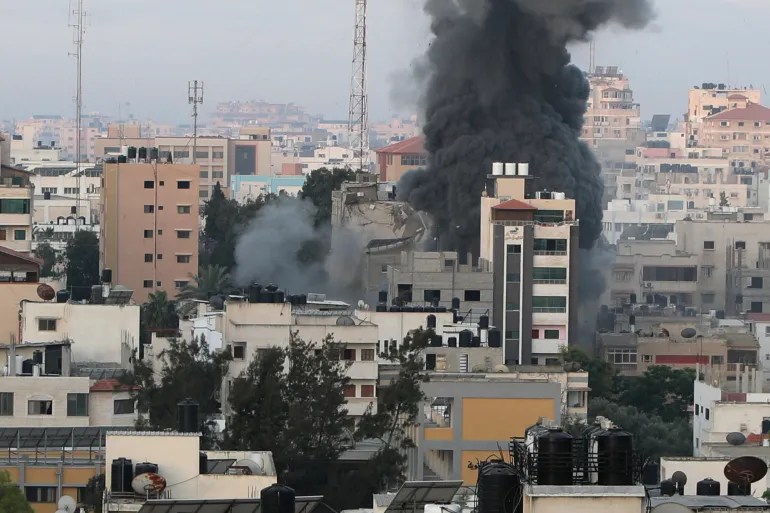
At 2 a.m. on Friday morning, the rockets and air strikes stopped.
After eleven days of fighting, Israel and Hamas agreed to a ceasefire mediated by Egypt. For Israelis who had spent nights running towards bomb shelters and Palestinians who had lived through Israeli bombardment of Gaza, the silence itself must have felt extraordinary.
It is unquestionably good news.
But calling it peace would be misleading.
The ceasefire ends the immediate fighting. Almost none of the political questions that produced it have been answered.
And perhaps that distinction, between stopping violence and solving the conflict that causes it, is the most important political story of this week.
Eleven days later
The human cost of this escalation has been severe.
More than 240 Palestinians have been killed in Gaza, including dozens of children, according to Palestinian health officials. Thirteen people have been killed in Israel.
Hamas and other militant groups fired thousands of rockets towards Israel. Israel conducted extensive air strikes across Gaza, saying it was targeting Hamas’s military infrastructure.
Friday’s ceasefire therefore matters enormously. Every day that the fighting continued created another opportunity for another family to be killed.
But what exactly has changed politically since the fighting began?
Hamas still controls Gaza.
Benjamin Netanyahu is still Prime Minister of Israel.
The Palestinian Authority still exercises limited control in parts of the West Bank.
The dispute over Jerusalem remains.
The Israeli-Palestinian peace process remains effectively frozen.
The conditions that existed before the first rocket was fired have largely survived the final one.
That makes this ceasefire simultaneously a success and a failure.
It succeeded at the most urgent objective: stopping people from killing one another.
It failed, at least so far, to provide any obvious route towards preventing the next confrontation.
Why Egypt matters
One aspect of the ceasefire that I find particularly interesting is who helped negotiate it.
Egypt.
The United States remains Israel’s most important international ally, and President Biden spoke repeatedly with Prime Minister Netanyahu during the fighting. But Egypt was crucial in communicating with both sides and eventually mediating the ceasefire.
That says something important about international politics.
Influence is not always held by the most powerful country.
Sometimes it belongs to the country capable of speaking to people who refuse to speak directly to each other.
Egypt has diplomatic relations with Israel while also maintaining channels of communication with Hamas. That gives Cairo something the United States does not possess in exactly the same form: access to both sides.
Diplomacy can therefore depend less on who has the largest military and more on who can get everyone to answer the telephone.
This is also why international relationships that appear contradictory can sometimes be useful.
Countries are frequently criticised for maintaining relations with governments or organisations they strongly disagree with. Sometimes that criticism is justified. Diplomatic relationships can legitimise terrible behaviour.
But complete isolation has a cost too.
If nobody talks to an adversary until the adversary becomes agreeable, diplomacy becomes useful only after the problem has already been solved.
Biden’s difficult position
The fighting has also presented President Biden with one of his first major foreign-policy tests.
The United States strongly supports Israel and provides it with substantial military assistance. Biden repeatedly defended Israel’s right to protect itself from Hamas rockets.
At the same time, his administration faced increasing pressure, including from within his own Democratic Party, to push Israel harder towards a ceasefire as Palestinian civilian casualties increased.
Eventually, Biden told Netanyahu that he expected a “significant de-escalation”.
This creates an interesting question about alliances.
What does being an ally actually require?
The simplest interpretation is loyalty: if another country is your ally, you support it when it is threatened.
But alliances cannot mean unconditional agreement. If friendship between individuals sometimes involves telling somebody that they are making a mistake, surely relationships between governments should allow the same thing.
America can believe Israel has a legitimate right to defend its civilians from Hamas rockets while also questioning whether particular Israeli actions are proportionate or strategically useful.
Those positions are not contradictory.
In fact, an ally may have more ability to influence a government’s behaviour precisely because the relationship is strong enough to survive disagreement.
Everyone can claim victory
There is another strange feature of this ceasefire.
Both sides can present themselves as winners.
Netanyahu can argue that Israel severely damaged Hamas’s military capabilities and demonstrated that attacks on Israeli cities would bring an overwhelming response.
Hamas can argue that it survived eleven days against a vastly stronger military and positioned itself as the Palestinian force willing to fight over Jerusalem.
This is politically useful for both.
It is considerably less useful for civilians.
This is one of the problems with measuring victory in conflicts like this. Governments and armed groups can achieve political objectives even while the populations they claim to represent suffer enormously.
Hamas can gain political prestige while Gaza is destroyed.
Israel can damage Hamas while Israeli civilians spend nights in shelters and relations between Jewish and Arab citizens deteriorate.
A military victory and a human victory are not necessarily the same thing.
And if both sides can emerge from eleven days of destruction claiming that the confrontation strengthened their position, there is a disturbing possibility that the political incentives which produced the violence have not disappeared at all.
What happens when everyone stops watching?
This is what concerns me most.
International attention is enormous during wars.
Presidents make telephone calls. The United Nations meets. Television networks broadcast continuously. Governments demand ceasefires.
Then the ceasefire arrives.
The cameras move somewhere else.
But Palestinians and Israelis cannot change the channel.
The difficult political questions remain exactly where they were.
What will happen to Gaza?
What happens to Israeli settlements in the West Bank?
Can Palestinians realistically achieve an independent state?
How can Israel obtain genuine security without permanently controlling another population?
What happens to Jerusalem?
What political future exists for Palestinians when their leadership itself is divided between Fatah and Hamas?
None of these questions has an easy answer. Some may not currently have an achievable answer at all.
But refusing to address them because they are difficult does not make them disappear.
It simply means the next crisis begins with the previous one’s problems still waiting.
Last week I wrote that the world pays attention when buildings begin burning and much less attention to the failures that make them burn.
The ceasefire now tests whether that was true.
If international diplomacy disappears along with the rockets, then we have not really solved anything.
We have stopped the clock.
And Then, Belarus
Just as this week appeared to be ending with the Gaza ceasefire, something extraordinary happened in Europe today.
A Ryanair passenger flight travelling from Athens to Vilnius was diverted to Minsk after Belarusian authorities said there was a bomb threat. A Belarusian MiG-29 fighter jet was sent to escort the aircraft.
When the plane landed, Belarusian authorities arrested Roman Protasevich, an opposition journalist who had been living outside the country.
The supposed bomb threat reportedly produced no bomb.
That sequence of events should be alarming far beyond Belarus.
Protasevich is a critic of President Alexander Lukashenko, whose disputed re-election last year produced enormous demonstrations and a severe government crackdown.
Governments arresting their domestic opponents is unfortunately not unusual.
Potentially using the machinery of the state to divert an international passenger aircraft in order to reach an opponent who is physically outside your territory is something different.
There were ordinary passengers on that aircraft who had nothing to do with Belarusian politics.
If governments can force commercial aircraft passing through their airspace to land because somebody they want to arrest happens to be sitting in seat 12A, then political repression is no longer confined neatly within national borders.
There are still many facts about today’s incident that need to become clearer, and I don’t think it makes sense to decide exactly what happened before more evidence emerges.
But one principle seems fairly straightforward.
People boarding civilian aircraft should not become pieces on a government’s political chessboard.
This week began with the question of how governments stop violence.
It ends with a reminder of why limits on government power matter in the first place.

