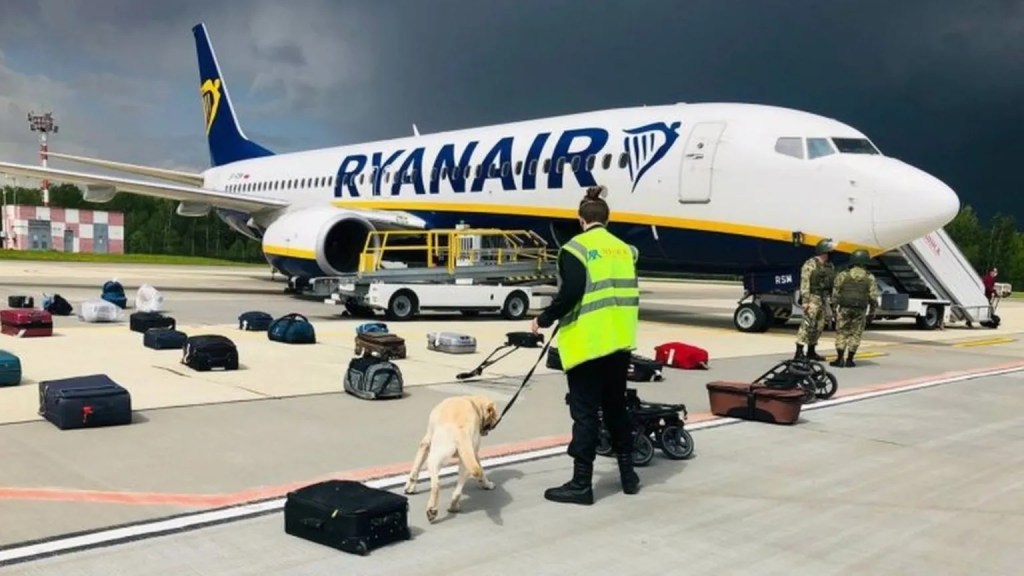
Last Sunday, a passenger aircraft travelling between two European Union countries was diverted to Minsk.
One week later, that single flight has become an international political confrontation.
Ryanair Flight 4978 was travelling from Athens to Vilnius when Belarusian authorities informed its pilots of an alleged bomb threat and the aircraft landed in Minsk. Once it did, Belarus arrested opposition journalist Roman Protasevich and his girlfriend Sofia Sapega.
No bomb was found.
Since then, the European Union has responded remarkably quickly. European leaders have called for new sanctions, urged EU airlines to avoid Belarusian airspace and moved towards preventing Belarusian airlines from entering European airspace and airports. Several governments have condemned the incident in unusually strong terms.
At first, this seems like exactly how the international system is supposed to work.
A government violates an accepted rule. Other governments impose consequences.
But this week has made me wonder about the much harder question that comes afterwards.
What happens if the consequences don’t work?
The issue is bigger than one journalist
It would be easy to see this story primarily as an attack on Roman Protasevich.
It certainly is one.
Protasevich helped operate NEXTA, a media organisation that became important during the enormous demonstrations against President Alexander Lukashenko following Belarus’s disputed presidential election last year.
He had left Belarus.
That should have placed him beyond the immediate reach of the Belarusian government.
Instead, he boarded a commercial aircraft in Greece and was arrested several hours later in Minsk.
But focusing only on Protasevich misses why European governments have reacted so strongly.
There were more than one hundred other people aboard that aircraft.
They were not political activists attempting to enter Belarus. They were passengers travelling between Athens and Vilnius.
That transforms the incident from domestic repression into an international problem.
Governments possess enormous authority inside their own territory. Airspace is part of that sovereignty. Aircraft flying above a country cannot simply behave as though the government beneath them does not exist.
But sovereignty cannot reasonably mean that civilian aviation becomes an instrument for capturing political opponents.
Otherwise, every dissident, journalist or activist travelling internationally would have to ask not only where their aircraft is landing but which countries it happens to fly above.
That would make repression geographically portable.
Europe’s response
The European Union’s reaction has been unusually fast.
EU leaders meeting on Monday condemned the forced landing, demanded the release of Protasevich and Sapega, called for an international investigation and agreed that further sanctions should be prepared.
They also called on European airlines to avoid Belarusian airspace and began the process of preventing Belarusian carriers from using EU airspace and airports.
These measures make political sense.
Belarus used aviation to create political leverage. Europe is responding through aviation.
But sanctions are easier to announce than to evaluate.
Their purpose is presumably not simply to demonstrate that European governments are angry. The objective should be to change behaviour.
That raises three questions.
What behaviour are sanctions trying to change?
Who will actually bear their cost?
And what happens if Lukashenko decides that paying that cost is preferable to changing his behaviour?
Those questions apply to sanctions almost everywhere, not only Belarus.
Punishment and persuasion are different things
I think I previously understood sanctions mainly as a form of punishment.
A government behaves badly, so other governments damage its economy until it stops.
But that assumes political leaders experience economic pain in the same way their citizens do.
They don’t.
If sanctions reduce trade or investment, an authoritarian president does not personally become unemployed. Ordinary workers might.
If an airline loses access to routes, political elites may find alternative methods of travel. Employees and passengers have fewer options.
That does not mean sanctions should never be used. Doing nothing also has consequences. If diverting a passenger aircraft produces only an angry statement, another government may conclude that the political benefits of similar behaviour exceed the costs.
But sanctions should probably be judged by more than how severe they sound.
A sanction can successfully punish a country while completely failing to persuade its government.
Those are different outcomes.
And if the ultimate objective is changing government behaviour, the distinction matters.
Lukashenko has somewhere else to turn
There is another reason European pressure may have limits.
Russia.
On Friday, Lukashenko travelled to Sochi to meet Vladimir Putin. While European governments are attempting to isolate Belarus, Putin offered him public support.
This changes the calculation considerably.
Belarus is not an island.
Its economy and security are deeply connected to Russia, and Moscow has already provided Lukashenko with important political and economic support.
That means European sanctions do not operate in isolation either.
Imagine sanctions increase the cost of Lukashenko’s confrontation with Europe by ten.
If Russia is willing to absorb five of that cost, Europe’s leverage has effectively been reduced.
Obviously international politics cannot actually be calculated so neatly. But the principle seems important.
Pressure works only when the target has nowhere cheaper to go.
And Lukashenko has Moscow.
Russia benefits from this too
Putin’s support is not necessarily charity.
A Belarus increasingly isolated from Europe becomes more dependent on Russia.
That gives Moscow leverage.
For years, Lukashenko has attempted to maintain Belarus’s close relationship with Russia while still preserving his own independence. He needs Russian support but presumably does not want Belarus to become simply an extension of Russian power.
Western isolation makes that balancing act harder.
Every European sanction can therefore have two effects simultaneously.
It can weaken Belarus’s relationship with Europe.
And strengthen Belarus’s dependence on Russia.
That creates an uncomfortable possibility: a policy designed to pressure Lukashenko could also push him closer towards the one government most capable of helping him resist that pressure.
This does not necessarily mean sanctions are a mistake.
It means foreign policy rarely allows governments to choose an action without also choosing its side effects.
Why would Lukashenko take the risk?
This is perhaps the question I find most interesting.
The Belarusian government must have understood that arresting Protasevich in this manner would create an international reaction.
So why do it?
One possibility is that the intended audience was not primarily Europe.
It was Belarus.
Authoritarian governments survive partly by controlling what opposition movements believe is possible.
Protasevich had left the country. He was operating from abroad. Exile had apparently provided some protection from the Belarusian state.
His arrest sends a very different message:
Leaving does not necessarily make you safe.
That message may matter more to Lukashenko than another round of European sanctions.
If the objective is discouraging opposition, then the international outrage might even strengthen the domestic signal. The entire world knows how far the Belarusian government was apparently willing to go to reach one critic.
This is where analysing government behaviour becomes uncomfortable.
Something can look irrational from one perspective and completely rational from another.
From the perspective of Belarus’s international reputation, the decision seems disastrous.
From the perspective of regime survival, intimidation may have considerable value.
Understanding that does not justify it.
But it helps explain why simply telling authoritarian governments that their behaviour is unacceptable so often fails.
They may already know.
The problem with international rules
Politicians often speak about the “rules-based international order”.
This week demonstrates both why those rules matter and why they are fragile.
There is no world government sitting above Belarus with police officers capable of arresting Lukashenko.
International rules therefore depend on something more complicated: governments deciding that violating them will produce enough political, diplomatic or economic cost that following them is preferable.
Usually, that works.
Aircraft cross borders every minute because governments broadly accept rules governing civilian aviation. Diplomats operate abroad because governments generally respect diplomatic protections. International trade functions because states usually honour agreements.
These systems can appear permanent because we rarely notice them while they are functioning.
Then somebody tests one.
The response matters not only because of what Belarus did but because other governments are watching what happens afterwards.
If there is no meaningful cost, the rule becomes weaker.
If the punishment is enormous but fails to change anything, another problem emerges: the international community discovers the limits of its own power.
So what should Europe do?
I don’t think the answer is simply “more sanctions”.
Nor do I think Europe can ignore what happened.
The better approach may be to distinguish between different objectives.
First, civilian aviation needs protection. An independent investigation into what happened to Flight 4978 is therefore important.
Second, sanctions should be targeted as closely as possible towards officials and institutions responsible for repression rather than becoming punishment for ordinary Belarusians.
Third, Europe should continue supporting independent journalists and civil society rather than assuming economic isolation alone will produce political change.
And finally, Western governments need to recognise that Russia is part of the equation.
A strategy towards Belarus that pretends Moscow does not exist is unlikely to succeed.
None of this guarantees Protasevich’s release.
That may be the most frustrating reality.
Countries can condemn an injustice without possessing an easy mechanism for reversing it.
Power is not the same as control
I think this is the part of politics I am beginning to understand differently.
The European Union is enormously powerful economically.
The United States is enormously powerful militarily and financially.
Russia is enormously influential in Belarus.
And yet none of them can simply decide what happens next.
Power does not mean control.
It means possessing tools capable of changing somebody else’s calculation.
Sanctions are one of those tools. Diplomacy is another. Economic incentives, alliances and international institutions are others.
But every tool works only if the person on the other side believes responding to it is better than resisting it.
Lukashenko appears to have decided that maintaining control inside Belarus matters more than maintaining good relations with Europe.
Europe now has to decide how expensive it can make that choice.
And Russia gets to decide how much of the bill it is willing to help him pay.
That is what makes this more than the story of one diverted aircraft.
It is a test of something much larger:
not whether the international community knows when a government has crossed a line, but whether it can actually do anything once that line has been crossed.

